Thursday, November 8, 2012

Central part of Sado

The central part of Sado island is rich in temple and historical places. The plains which extend between Mano 真野 and Sawada 佐和田 on the West coast and Ryotsu 両津 on the East coast house the most interesting temples from the point of view of tourism, a conservation site for a local bird (the toki) and most of the island population. Near Mano, we first visited the tomb of emperor Juntoku, who was exiled to Sado and died here. The name of the place in Japanese is 真野御陵. Most of the area is off-limits and only the emperor can enter to the restricted areas. Still we can have a look at the entrance of the tomb.


Not far from there, there is another old temple called Kokubunji 国分寺. This temple is not often visited by tourists and that makes it interesting. The atmosphere is quite relaxed and buildings look nice.


Again, a short drive away, there was another cool temple, Myosenji 妙宣寺, whose most attractive feature was a nice pagoda at the very entrance. Moreover, some of the trees around it were already "wearing" autumn foliage.


The last temple we visited in Central Sado was in Niibo village and it is probably the most important temple in the island, Konponji 根本時. This temple was built on the grounds were the famous monk Nichiren lived while exiled in Sado. The temple is quite atmospheric and buildings look very old, which is always a plus.


There is also a statue representing Nichiren...


After so many temples, it was time to go to the West coast, to Nanaura Coast 七浦海岸, where our first hotel was located. Before going to the hotel, we could have a look at the Meoto Iwa, or Married rocks (husband and wife).


Finally, such an intense day needed a well deserved dinner in our minshuku! Lot's of sashimi and seafood! :)


Southern area of Sado Island (佐渡)

Sado Island (佐渡ヶ島) is the sixth largest island in the Japanese archipelago. Historically, this island was a places for exiled people to stay. Many exiled lived here in the past, including one emperor, a No theater master and a famous Buddhist monk, Nichiren. Later, in the Edo period, gold was found and it attracted many people to the island. Today, it is a very rural and isolated place in which good food and traditions are the norm. It is located off the coast of Niigata prefecture in the Sea of Japan and the connections to the main island are by ferry. The car ferry is really expensive, around 30000 yen or 300 euros for the round trip. However, during November, the ferry company, Sado kisen, is offering a very nice offer and the car fee is now only 10000 yen (or 100 euros). Therefore, we went there for a long 3-day weekend. (we intended to go there for 2 days, but our ferry back got cancelled and we had to stay there one more night!)


View Larger Map


Our ferry departed from the port of Naoetsu 直江津 and arrived in Ogi 小木 in the southern part of the island. The ferry takes a bit more than 2 hours, but the fact that you can use your own car in the island is great! Since we had our own wheels, we could do quite a lot of sightseeing in the 2 full days +  we were there. We started with a visit to a really beautiful and picturesque small fishing town, Shukunegi 宿根木. Shukunegi is a small town inside a wooden fence to protect it from the sea winds. Streets are really narrow and compact and houses are made in a very traditional way. There are some houses which can be visited and provide a further inside into the lives of these people.
 

On the way back to Ogi, we stop in a mysterious temple inside a cave, Iwayasan 岩屋山. The approach to the cave is really spooky, following a hiking trail in a bamboo forest with lots of forest sounds and no people around. We did not meet a single person during our visit. However, there were many small buddha statues and standing jizou around the cave. The cave itself was also very interesting, with many more stone buddhas on the walls and some altars, it really looked like a buddhist temple.


In the surrounding mountains, leaves had started turning reddish to match the cooler season. And a giant stone buddha could be seen popping out the trees.


After our visit to Iwayasan, it was time to come back to Ogi and enjoy some local delicacies! Burikatsudon ブリカツどん, deep-fried breaded Japanese amberjack (according to wikipedia...) on rice...


...and Ika kamameshi, イカ釜飯, which Naoko wisely described as squid Japanese Paella. ;)


With our stomachs full, it was time to enjoy the local tourist attraction, the Taraibune たらい船, in the nearby port. Of course, we also tried to navigate our boat and that was the most interesting thing.


After our ride in this funny looking boats, we traveled north. However, on our last morning in Sado, we took the ferry again in Ogi and could do some extra sightseeing around the town. We could go to Yajima and Kyojima 矢島・経島, and the islands with the beautiful red bridge became one of the highlights of the trip!


Wednesday, October 31, 2012

Open doors day at Mitaka Campus

Last Friday and Saturday, it was the Open Doors Weekend in the Mitaka Campus of the National Astronomical Observatory of Japan, NAOJ, the place where I work. As every year since I work here, I joined the event as staff. The biggest difference this year was that I could speak "acceptable" Japanese, so I became part of the team who has to explain our work to visitors... Let's say I tried my best... and anyway, next year, I will be more fluent! :P


What can we see during this event in the campus? Is there really an astronomical observatory not so far from central Tokyo? The answer is yes. Our campus is the original campus of our institution and there are many historical places in it. For example, the Japanese Standard Time position was defined at the beginning of 20th century from a position in the campus. Besides, there are many old nice telescopes and some new ones!


I work in the so-called Advanced Technology Center in the development of the Atacama Large Millimeter/Sub-millimeter Array receivers. I will not explain what those receivers are, but I will post some photos. If you want to listen to the explanation, you will have to come to the event next year! ;)


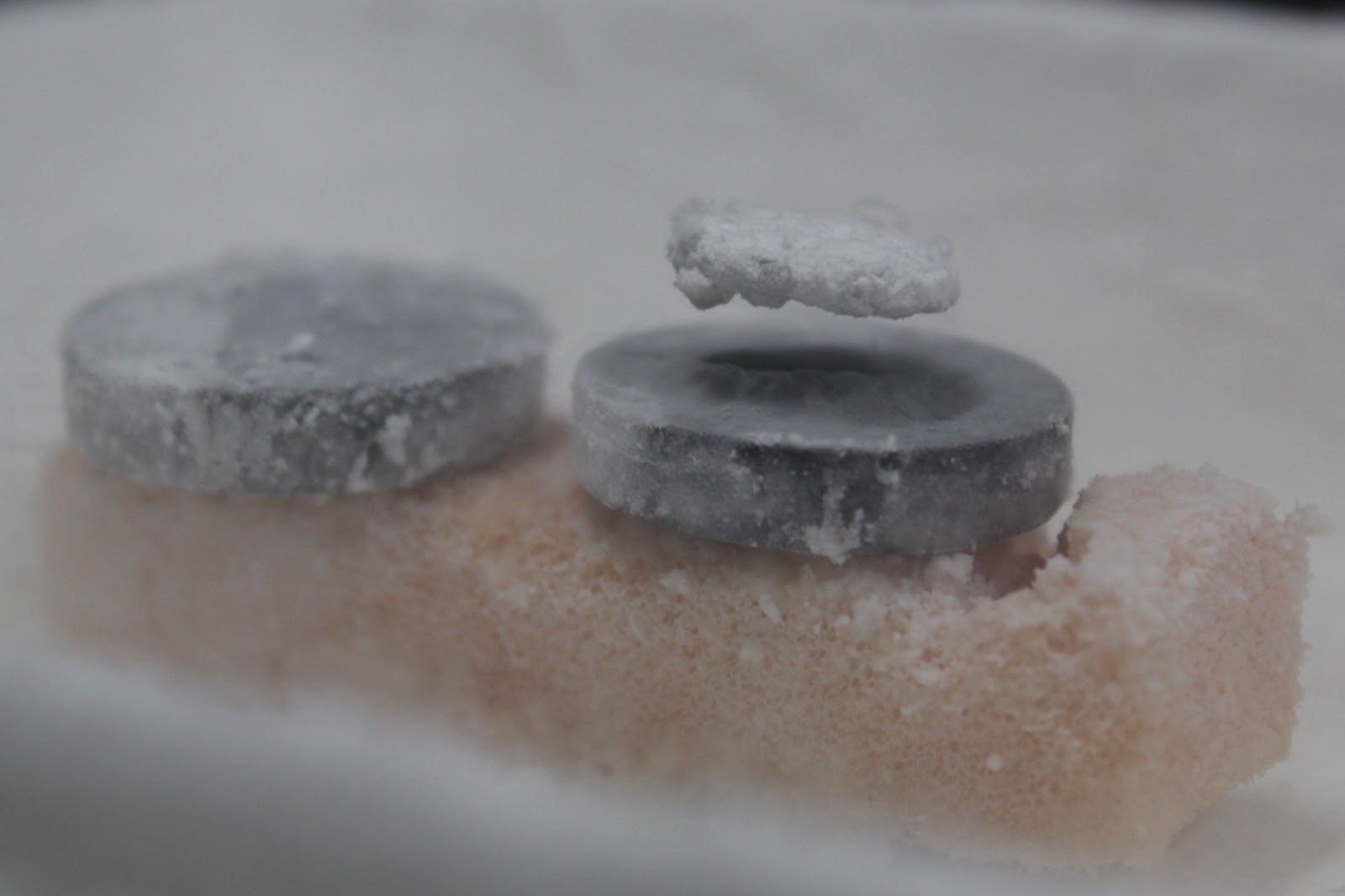
Besides this great opportunity to see and even touch state-of-the-art astronomical receivers, there are some interesting technology and physics demonstrations. In my opinion, the coolest is the Meisner effect experiment. The core of our receivers is superconductivity and we have to deal with it every day. Therefore, it is nice to show some really cool effect based on it which makes kids really amazed! The Meisner effect is magnetic levitation due to superconductivity and it is used for the Maglev trains. Basically, when a metal becomes superconductor no magnetic lines can enter into it. So, if you put a magnet on it, the magnetic lines cannot enter the metal and create the magnetic levitation of the magnet. Of course, to get a metal to become superconductor, you have to cool it below its critical temperature, Tc, which can be close to 0 degrees Kelvin. If you use a High-Tc superconductor like YBCO, you can get superconductivity at around 77 K which is liquid Nitrogen temperature. That's what we do every year and get cool results like I show you below!


Of course, after all visitors left and we cleaned all the building, we relaxed with some beers and snacks! or Hanseikai 反省会.


Thursday, October 25, 2012

歓迎会 Kangeikai

Recently, our group at work has one new member, Kojima-san. He used to be a PhD student in our group some years ago and did a great job. After graduation, he tried his luck in NTT, a big company, and after some years, decided to come back to superconductors and astronomical receivers (yes, that is my current job too ;) ).

Yesterday, we all met together and went for dinner to welcome him back. That is a very typical situation in a Japanese company. When a new member joins the work group, there is always one dinner to welcome him/her, the so called Kangeikai 歓迎会. When one member leaves the group, than there is a farewell party or Kansoukai, 歓送会.


If you have ever come to Japan, you must have noticed that Japanese people love drinking with colleagues. Actually, "going out for dinner" is normally expressed as "going drinking" and Japanese would say in English something like "Let's go drink together sometime" instead of the most common "Let's hang out/ go out/ go party sometime" for Westerners.

There are many occasions Japanese coworkers go drink together: new group members, group members leaving, end of the year dinner, new year dinner, hanami... or any time there is something to celebrate.

Restaurants also cater for these parties appropriately. It is common to be offered all you can eat and drink menus, Tabehoudai 食べ放題 and Nomihoudai 飲み放題 respectively. Normally, there is a time limit for these. Yesterday, we went for one of these all you can eat and drink menus and the time limit was 2 hours, which is about standard. The price depends on the restaurant, but prices around 3000 or 4000 yen are common.

If you are planning to visit Japan in the future, going for an all-you-can-eat menu can be a good option! What do you think about it? Would you like to try this kind of buffet style dinners including drinks or would you rather order dishes/ drinks directly?

Monday, October 22, 2012

Sunny weekend in Tokyo

This weekend has been pretty intense. Weather was great and therefore, we went for barbecue to a famous park, Mizumoto-koen. Going out for BBQ when the weather is good is one of the favorite pastimes of people in Tokyo. Basically, you are giving one spot in the barbecue area and there, you bring all your stuff and eat and drink freely. Once you are done, you must clean everything and leave the place as you found it.


On Saturday night and then again on Sunday, I met some friends visiting Japan these days. We went for a walk in Harajuku in order to look for cosplayers, and then, we went to Ginza, to enjoy the upmarket shopping area and some nice traditional crafts shops.


We wrapped up the night in an izakaya in Okachimachi area. This is the whole crew: Francis, Chris, Jesus and Andres.


Friday, October 19, 2012

Prambanan

In Japan, there are national holidays in most months. However, in June there is none. Actually, from Golden Week in the beginning of May until Sea Day in mid July, there are no holidays at all. It is two months and a half just working amid the Japanese rainy season. This routine sometimes makes you feel slightly blue, specially when it has been raining for days without stopping!

Last July, we decided to break routine and have a 5 day holiday to go to Indonesia. Direct flights to Indonesia take around 8-9 hours, but we had quite some miles from Delta/KLM and decided to use them for a Tokyo-Singapore round-trip flight. From Singapore, it was easy to get to Indonesia using Air Asia or any other cheap company. The aim of our trip was clear, we wanted to visit Borobudur and Prambanan in Jogyakarta, Central Java, and the island of Bali.

Upon arrival in Jogyakarta airport, the heat and humidity of the tropics welcomed us to Indonesia. We left the airplane in the middle of the tarmac and walked to the arrivals building by ourselves in a very chaotic way. That was the first sign we were back traveling! Next to us, in the visa counter, there were the typical westerners traveling for a long time in South East Asia: big backpacks and some T-shirt with the local beer of some neighboring country... after getting our visa on arrival, we were greeted by a taxi driver I had chartered for the day. Yes, traveling from Japan, time is minimal, so I had to give up on cheap options and I had to go for the most time efficient solution. Anyway, chartering a taxi for a full day is less than 3000-4000 yen (around 30-40 euros). 

Our first stop was Prambanan, but on the way we stop to see some smaller temples like Kandi Kalasan


 and to taste the local food:


After lunch, we visited a nearby temple, Candi Plaosan which turned up to be really impressive, specially since we were craving for cool temples!


Just a couple kilometers from Plaosan, the UNESCO World Heritage site of Prambanan stands in all its magnificence. This Hindu temple complex is composed of several massive temples made of stone which seem to try to reach out for the sky.


The first view of the site is surely breathtaking, but the crowds and the high price (slightly less than 20 USD per person) make this place less out-worldly.


When the Sun goes down, the contours of the tall temples shadow the sunset sky and dwarf all the crowds watching the day agonize away.
 

Next to Prambanan, there is another small temple which is well worth visiting, Candi Sewu. It is a Buddhist temple and that contrasts quite a lot with Prambanan. Architecture is quite different and most importantly, there are many Buddha statues! ;)


From there, our taxi driver took us to our hotel for the night: the only hotel within Borodupur, the Manohara hotel, which turned out to be one of the highlights of the trip, together with the temple itself. Without any doubt, one of the most impressive sites in Asia and probably in the world.

Thursday, October 18, 2012

Back to life for good!

Hey there!
Long time not seen! It has been more than two years since I wrote my last post. At that time, I was facing new life conditions in Japan and felt there was no time left for blogging. I am still too busy, but sometimes I feel I miss writing in this, my little window to the world.

I have changed the blog address for a change. Now, it is kita1010.blogspot.com. You will probably wonder what is that?! Well, that is the place where I live! Kitasenju, in Adachi-ku, Tokyo. Senju has the same reading in Japanese as the number 1010 and therefore, it is often shortened. Kita just means North. Adachi-ku is famous for being the most dangerous place in Tokyo, but believe me, this is way safer than any place in Europe or the USA! not kidding!

So from now on, I will continue writing in this blog from time to time. What will I talk about? Well, the usual stuff... but now, I will probably focus in my trips and life in Japan. There are so many cool things going on around here. And I have being in so many cool places in the last two years!
My current map of visited countries is this one:


So I have visited 61countries and I have not told you about it... I will try to be not so boring and will post many photos :)

Well, this is probably enough for starters. I hope this time I can really manage to post updates often! See you soon!

Friday, April 8, 2011